I am a consecrated woman—
I was born on the fourth day,
But my father only cherished the first.
Was it because he saw me as his miracle
Since he was a child?
Or a hidden legend folded in his palms,
A legend shaped like the letter S
Like the first day of the final month
Was it a prophecy or a written revelation?
Or a greater secret grew between his fingers?
Since that day, I have seen the world
as a single, solid one—
Unbreakable, indivisible, whole.
I fold the light in my wings
Fly on the wings of a dove he once saw in me,
Swim in clouds shaped like a bride,
Feed my town’s lake grains of wheat,
Dress the sun in the moon’s light—
It gleams from the window
Overlooking the eye of a wise cat.
Each morning, I break the beak of a crow,
Cradle a bird with broken feet.
Since that day, I have hated the sound of a train
Passing through my street.
I love the Nile I gave birth to,
I love the voice of Amira* flowing from
a heavenly river
That carries my first letter,
Wearing the robe of Alice in Wonderland,
Its surface bears the remnants of a red shirt
From a time long gone—
And a house clutching winds and black clouds.
Since that day, I have hated the letters M and B,
And I have loved A, S, and H.
I despise the crow that brought me a farewell
But I cherished the bird’s wing that brought me Solomon’s ring.
I loathe the amulet that destroyed a land’s remains,
And adore the sorcerer who promised me abundance.
Father…
I love the One,
But I am the daughter of the Fourth Day.
You wrote me into the One—
I lived in it, it lived in me—
Yet I have never forgotten the Fourth Day
That marked me,
And made me a woman
from Four to One.
*Amira: is my mother’s name, translating to Princess in English.
Why do you write?
A simple question— often asked
As often as the hairs on a child
Born with two heads,
As many as the sighs of a woman
Who saw her dead father
In a dream after a long absence.
Each time I answer
My soul whispers,
That Stir my heart,
Pulling it toward a deep pit
Where my hidden, split half is buried—
The half I concealed, even from myself
Since the birth of my new self,
The one I promised would become a woman never born before,
With a bloodstream that flows with poetry.
And the translation of my soul
Into languages only those
Who approached the eye of my heart can understand.
I repeat the question to myself
I fall silent for a moment—then I respond
Each answer carries pieces of me
On a journey
Across distant seas
Where I once cast parts of myself.
Seas where I confided in long ago,
Told secrets to,
Secrets I lived with
On one broken wing,
With an eye,
With a blood fleeing
Its mother’s arms on the day of birth.
I drank poison
That flew from the antidote of a mute serpent.
A stranger asks:
‘’Why do you write?’’
I write so my pen may bleed
Into a cracked vessel—
A vessel pierced by a crow
Whose soul flew into a dead sea.
I write so a black bird might emerge
From a heart where
A rabid dog once dwelled,
And a cat with no tongue.
I write so the saliva of a cloudless sky
May drip—
A sky that lived in me,
Took hold of me.
I write to shake the dust of pain
That festered in my head.
I write to find a window
Overlooking a wind gone astray breeze
From a dead man’s grave.
I write so a cat may breathe—
A cat that lived without a nose.
I write so I won’t become Sylvia Plath*
Or Anne Sexton**.
I write to become a translucent flower
In the hand of every bird
That lost its broken wings.
So go on —
Ask me again: Why do you write?
*Sylvia Plath (1932-1963) was an American poet, widely regarded as one of the most influencal literary figures of the 20th century. She died by suicide on February 11,1963, at the age of 30.
**Anne Sexton (1928-1974) was an American poet known for her deeply personal confessional style of writing. She died by suicide on October 4, 1974, at the age of 45.
Poetry
is a fish flying through a sky without a mother.
Poetry
is a flower with two lips and one eye—
a lost kiss from a cat that does not meow,
a bird singing in a hungry mouth.
Poetry
is a refuge for an orphan
who lost his mother in the marketplace.
Poetry
is a moment of birth
after a long death.
Poetry
is a womb in pain
giving birth again,
a window where a blue dove sleeps on the sill.
Poetry
is the heart of a homing pigeon
that always knows the way
and never gets lost.
Poetry
is a wound bleeding
in a musical score.
A riderless imagination
that knows no reins.
Poetry
is wandering
in a sea with no shore.
Poetry
is music lost from its melody.
Poetry
is the candle
that never burns.
Poetry
is a prophet
who understands the language of birds—
a language that speaks without speaking,
letters that will never die.
Poetry
is a clock with no hands.
Poetry
is a bird
born with three wings.
A house with no walls.
A silent bleeding.
Poetry
is a moan without a scream.
a tango without music.
Poetry
is a star shaped like a broken heart.
Poetry
is a body with two hearts,
a cold knife that does not cut.
An apple that fell on Newton’s head,
salvation from a river
with no current.
Poetry
is a bird that rebelled against its flock—
a love that will never die.
Each time I write a poem,
I feel incomplete—
as though I’m planting a drop of water
in a river with no wings.
Each time I write a poem,
thoughts multiply inside me,
rebelling like a bull
escaping a ring of death.
Each time I write a poem,
an unknown volcano ignites—
one I had hidden
in the feathers of an orphaned bird.
And each time my words fly far away,
I feel a tangled yearning for them.
I run within myself,
hide inside me,
afraid of the gaze of a crow
that never learned to fly.
Each time my words fly far away,
my soul spins inside a lost identity—
like a war whose soldiers have no weapons.
My arms lose their way
in a sea filled with colored fish,
my feet lead me toward it—
toward a sun with a tender heart
that rains down clouds
shaped like whole, unpierced hearts,
never struck by Cupid’s arrow.
Each time I write a poem,
my words fly far away.
On a cold night,
a book sits before me, waiting.
A colored pen gazes at me,
watching with pity, asking:
‘’Why don’t you read?’’
I respond with silence
and a small gesture.
My book asks again:
‘’Why don’t you read?’’
I answer with a smile
and a promise.
Even my couch
was about to ask me
the same question
but chose silence instead.
Everything around me was still,
and yet Full of noise.
Even my hair was flying
on the notes of an indifferent breeze.
I touched my mouth—
and found it to be
a one-winged orphaned bird.
Even my eyes rebelled against me.
I heard my ears
agreeing on a mission
to a distant town.
Everything in me was quiet—
but roaring.
I do not know
if this is an innocent dream
or a reality I’ve lived and now recount?
Questions flutter
from my mind
to my blank page.
They take hold of my pen
in my place,
writing themselves.
Perhaps—
they will become
a poem.
A white, empty page—
had erased every extra color
laid upon it.
It bore all the colors,
even black—
that lingered as its longest companion.
It Clung to it ,
became part of it—
but it declared its rebellion.
It held on tighter—
so it rebelled harder. She resisted
Her strength surpassed its grip.
And so—
She became free.
I wrote a short, evocative poem—
I felt it end
at this one word: ’’Free’’.
Why did I feel a sting in my stomach then?
Was it because the poem sensed its own
incompleteness?
My intuition whispered: it was whole.
My heart rang the bell of silence.
Everything in me cried out: enough.
And yet—I was still pain
A strange feeling struck my blue bird;
it would not settle
until I moved to write another poem.
It wouldn’t fly
until I began digging through words
in the book of poetry.
They flew from my head
onto my white page.
I did not feel them—
they flew without wings.
They whispered into my mouth
instead of my ears.
I heard them,
felt them—
an incomplete poem.
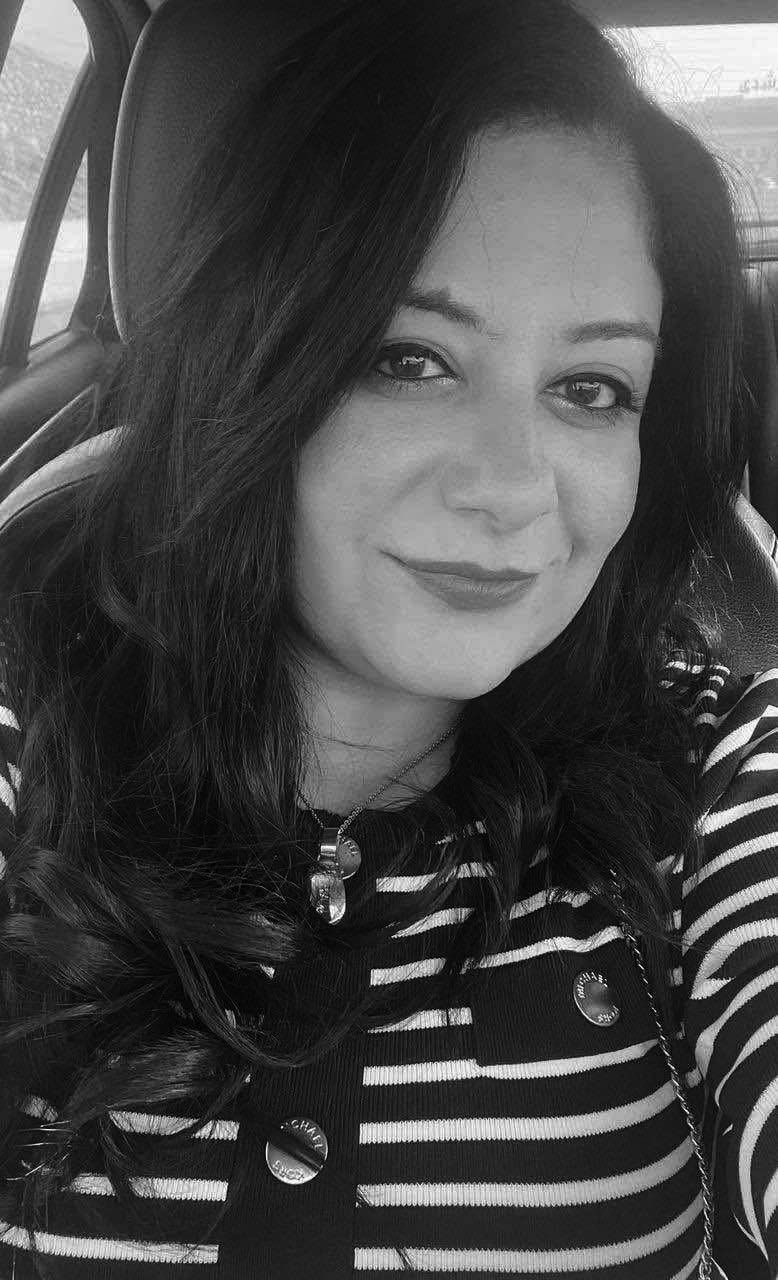
Sara Hamid Hawass (b.1983) is an Egyptian linguist, academic, writer and translator. She has a Ph.D. in linguistics teaches in the Faculty of Arts, Department of English, at Mansoura University, Cairo.