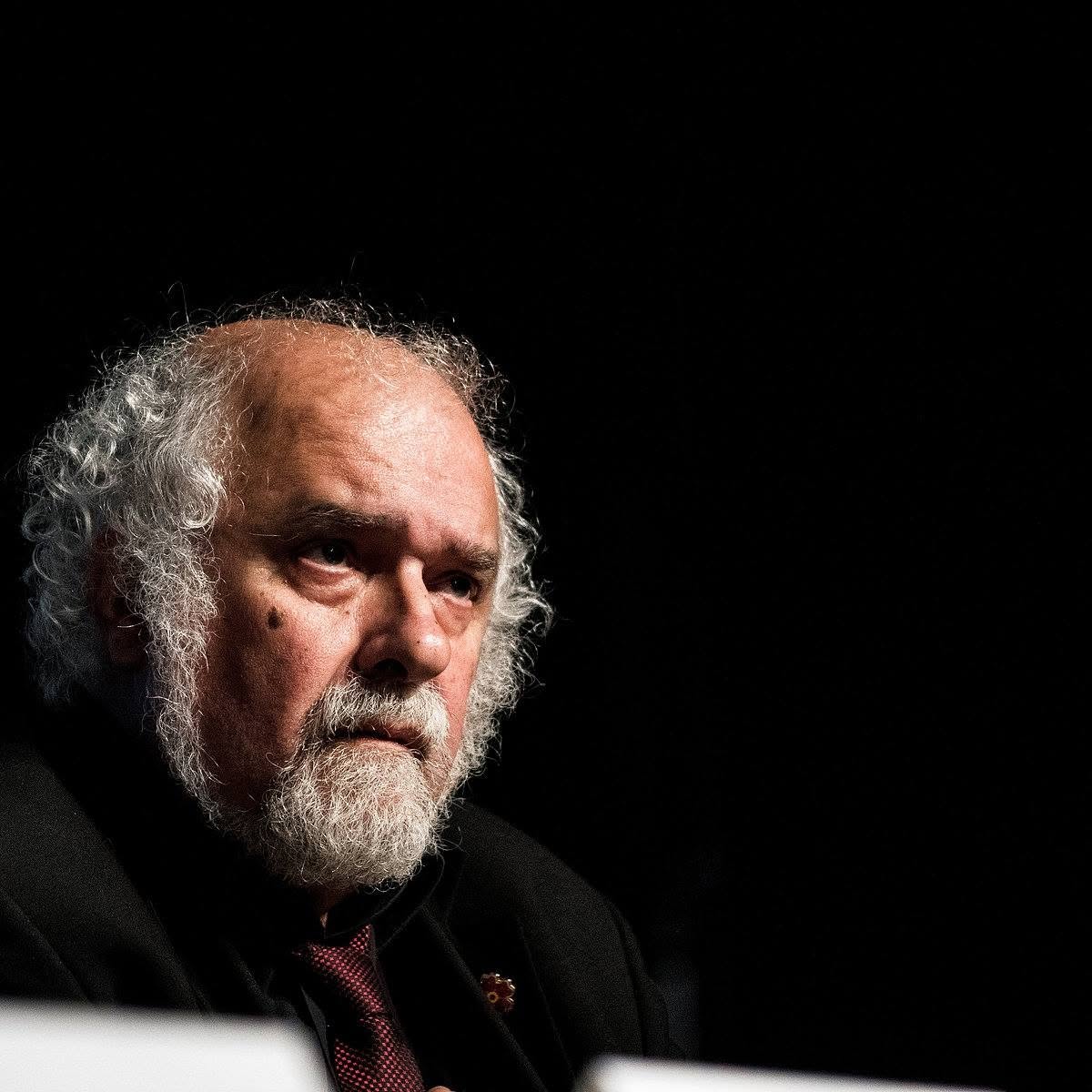
Ragıp Zarakolu, a former guest writer for Sigtuna Municipality, is a prominent Turkish publisher and advocate for freedom of expression and human rights. In an interview with Upplitt magazine’s Aron Berglund and Anisur Rahman, he recounts his struggles against threats and harassment, as well as the legal battles he has faced over a range of titles published by his Istanbul-based publishing house.
The list of publications from your publishing house launched in 1970s ) include more than 10 books (translations) of Greek literature, 10 books on the Armenian Question and five books related to the Jews in Turkey. There are also a number of books dealing with the Kurds in Turkey. What is the inspiration for you to have a focus on Greek literature, Armenian question, Jews and Kurds in Turkey?
So far, we have published translations from English, French, German, Greek, Armenian, Georgian, Arabic, Italian, and Spanish. Our Marenostrum series has become a series that claims the cultures and literature of the Mediterranean, our common sea, as 'ours.' Academic books and documentaries alone fall short in conveying the 'truth.' Meanwhile, we also published books in Kurdish, and bilingual titles too.
Although there are few, for example, we did a bilingual edition of a book by Plutarch in Ancient Greek/Turkish, and Emine Erdem’s “Somewhere a Rose, Weeps”, which tells the children’s testimonies of September 6-7 pogrom in İstanbul, in Modern Greek/Turkish.
In 1982, the biggest taboos were Socialism, Armenians, Kurds etc.. We got hold of Prof. Mete Tunçay’s documentation called “New Information on the Old Left” and published it, at a time when militarism was uprooting the left. My late wife, co-founder of Belge Publications Ayşe Nur was arrested. But surprisingly, we won the case in the military court. We got the books back. But the 1st Army commander didn’t care about the ruling and confiscated them again.
In 1992, we decided to go after another taboo. The Armenian taboo. Tough stuff. A topic the state is probably more sensitive about than the Kurdish issue. The reason for choosing this topic was, of course, to be able to show the roots of the authoritarian state tradition. And we managed to publish the first Turkish book on the subject, uncensored and unrestricted.
In 1994, we published Prof. Dadrian's book called “Genocide in International and National Law” which was released by Yale University. Again, a ban, again a court case. But in the end, we won. Acquittal! Another taboo had been broken.
In 1996, we tried to bring up another taboo, another taboo of official history: the Pontus / Black Sea Greeks taboo. At first, not much was said, but in 1998, when our Greek writer Andreadis was banned from entering Turkey, the attacks against us started, and this also got media attention.
Ömer Asan's book “Pontos Culture” was banned in its 3rd edition in 2002 as a result of the attacks in the media. This case ended with an acquittal. But the ban on our writer Andreadis entering Turkey didn't lift despite many campaigns.
In May 2017 the Belge Publishing House was raided by police who said they had orders to seize all copies of the book Stateless Kurds and Decisions Tougher than Death. Police also seized hundreds of books published in the 1980s and 1990s, despite having no orders to do so. What is the fate and state of Belge today?
My son Sinan Savaş Zarakolu is responsible editor of Belge Publishing. This week he was in Diyarbakir Book Fair. He is going on the same line and publishing challenging books like “Totally Unofficial: The Autobiography of Raphael Lemkin”. Lemkin is the father of term ‘Genocide’. Greek anarchist poet Katerina Gogou’s Poems. Within a few months it will be published Corry Guttstad’s book: “Antisemitism in and out of Turkey”.
In 1979 you were one of the founders of the daily newspaper Demokrat and took responsibility for the news desk on foreign affairs. The paper was banned with the military coup of 12 September 1980 and Ragıp Zarakolu was shortly imprisoned in 1982 in connection with this position in Demokrat. What is the last fate of the paper? What happened to your remaining partners and colleagues at Demokrat?
An undeclared civil war took place in Turkey between 1975 and 1980. The newspaper that reflected the most critical final year of this civil war in the press was Demokrat newspaper. I believe that the 10-month collection of the Demokrat newspaper will be an important resource for political scientists who will research the de facto civil war of 1975-80.
As a publishing house, we cared about publishing books on civil wars around the world and the transition to democracy in later periods, so that it would be easier to understand what had happened.
Dursun Akçam, the owner publisher of Demokrat newspaper, managed to leave the country through İzmir just a day before the September 12 coup. In exile, he facilitated the launch of Demokrat Türkiye in Germany, which included contributions from writers with different tendencies. In a way, this became a continuation of the newspaper in exile.
It was regularly published throughout the first half of the 1980s (mainly between 1982 and 1985).
Bir Gün newspaper, which continues the same tradition, started its publication on April 14, 2004; and went on until today.
What is the state of media, publishing sector and free expressions in Turkey today?
Turkish Journalists Union declared that 15 journalists in the prison now in Turkey: Ali Tarakçı, Ali Ünal, Erdal Süsem, Erol Zavar, Fatih Ergin, Hatice Duman, Hüseyin Aykan, İrem Delice, Mehmet Baransu, Merdan Yanardağ, Mustafa Gök, Nadiye Gürbüz, Sami Tunca, Selahattin Günday, Tuğba Tekerek. Journalists stood trial a total 610 times over the last year in Turkey.
Last week a book was banned during the printing process written by ex-mayor of Istanbul, Ekrem İmamoğlu who is in prison now.
Erdoğan’s authoritarian regime put a lot of elected mayors in jail. 16 mayors are in prison now. A wave of removing mayors from office and arresting them began in 2024, just after the elections. It happened after the 2019 elections also. These arrest campaigns began first in Kurdistan and now the wave of arrests reached as far as Istanbul.
How was your journey as a guest writer in Sigtuna?
After being nominated for the Nobel Peace Prize, I was invited to Sweden as a guest writer for two years. I was hosted by the Sigtuna Municipality and the Sigtuna Foundation—a century-old institution that advocates for interfaith dialogue—during 2014 and 2015. I grew fond of Sweden’s natural beauty and peaceful atmosphere, and I was able to pursue my research and writing more productively. I continue to write columns for three newspapers in Turkey.
I collected my articles under the title “Sigtuna Diary”. Unfortunately it could not be published. Because my computer was stolen at Berlin Airport on 19 December 2016. This was the day, a truck was deliberately driven into the Berlin Christmas market, leaving 12 people dead and more than 70 victims. I was there a few hours before I went to the airport. I am a survivor.
I married the librarian Monica Aström Zarakolu, we started a family and until 2016 we could go to Turkey together.
What are your ongoing projects?
I began to write a biographic novel, titled “Lamia” when I was in the USA, between 2004 and 2007. Lamia was the grandmother of my sons. My son Sinan’s wife Ferda is editing now. Hopefully it will be printed until İstanbul Book Fair, in December.
I am in preparation to write a book, under the title “My Cities”. A journey book. As a journalist, as a human rights activist, as a publisher I go all around the world. It will also be a kind of memoir.