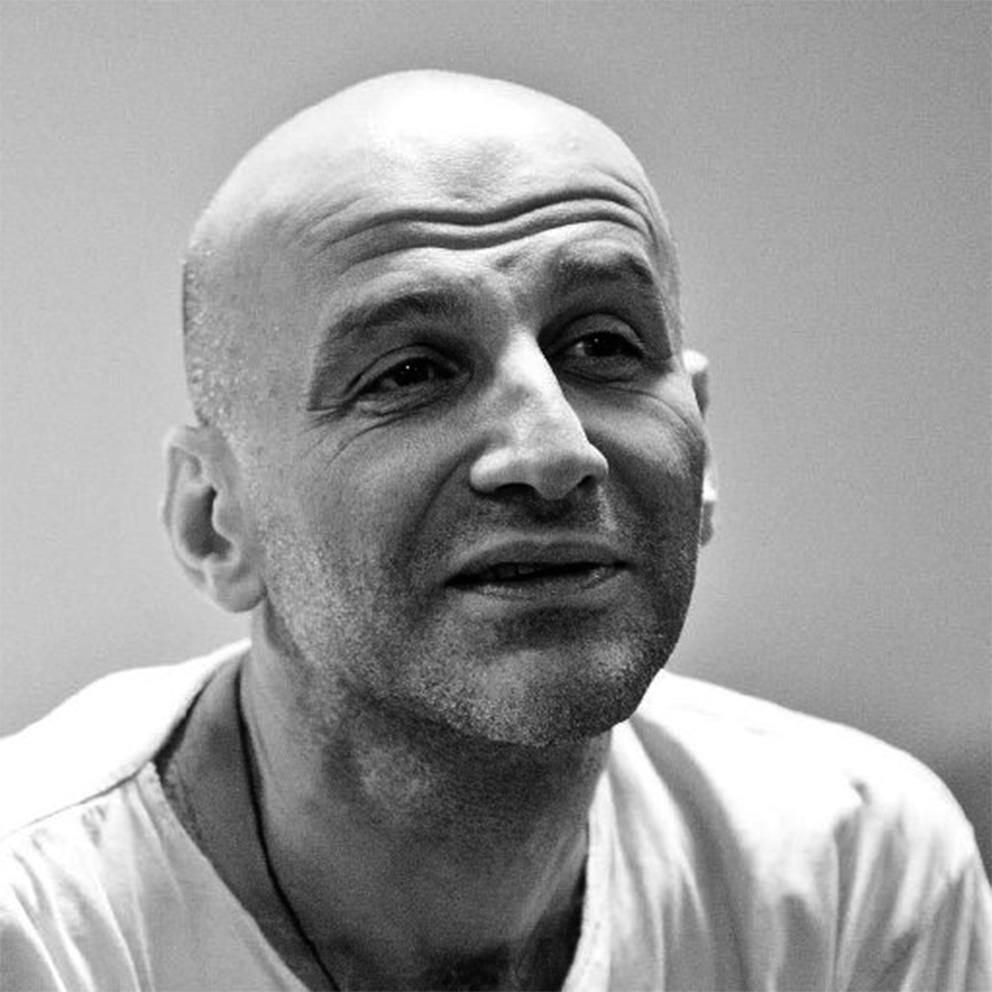
ÖVERSÄTTNING: TIM KERCHER, DALILA GOGIA, & LELA SAMNIASHVILI
Women love hospitals,
they dream of lying quietly,
especially with a psychiatrist,
sometimes even having children
just to spend a few blissful days in the
maternity ward.
This is where men and women are different.
Men don’t like hospitals.
For Besik Kharanauli
It’s so nice that you realize
you are happy today.
Today,
with your palms bleeding,
with your wrist cut,
with your forehead cracked,
with your elbows and knees blackened,
you are happy
to at last have truly fallen down,
fallen down one, two, three times,
fallen down in the dusty streets of your city.
You were excited when you fell,
were stumbling out from
the place of your country’s best poet.
You fell down
and realized
and realized
you truly fell –
you look at your bleeding palms,
the blood like ink
flows down to the fingers
making its way to
the pen
and you submissively write a poem,
a strange new poem
and feel happy
because
for the first time in your life
you have truly fallen and
you already know
what it is
to fall down
in your city
in your street
before your people
at your people’s feet
to fall down
to fall, fall
so that they can
raise you from the dust
take you home
to take care of you
and you,
once you’ve truly fallen,
rise
and quietly continue on your way,
the undying way of the fallen.
We can say, we move,
can say vehicles move,
the sun moves,
stars, galaxies,
everything moves,
which leads to just a single question:
does God move too?
And if so,
in what way does He move?
Is it at least a little like
moving in this world
(Or more like shifting in space
in a better world)?
Most likely
there is no similarity,
and He moves differently
and we’ll never attain even an understanding
of his laws of motion.
But
if we perceive Him
as God in Motion,
then
there is nothing motionless
in this world,
there is no center,
no supporting points to fix
Archimedes’ levers on
so that
the world swings and spins at their will.
But
doesn’t He move around?
He, the Son of man—
led out into the wilderness
walked on the salty sea
went up to Calvary
The Father taught Him how to walk.
Did The Father teach Him to walk the way
He Himself used to walk
in this world?
A moving God or motionless God?
Which do people prefer?
Which do people believe in?
Which do people love?
But does it matter
if He is everywhere?
Moving or motionless
He is everywhere,
here and there.
Is He everywhere
or
can He get everywhere?
In other words
if He truly moves,
He walks across the universe
and stays a while in the most outer-lying
regions too.
No matter how far away He is
He can reach us.
Like His Son,
who while walking through the tiny
land of Israel,
managed to reach
the most remote spots on Earth.
And what can we take from this?
Is it the case that
molecules are in constant motion,
that we are in motion,
walls
birds
comets
angels move
only if God moves?
Or vice versa?
He, and only He is in motion,
and
is that why we, the motionless—
people,
apple trees,
zeppelins,
beams of light,
just seem to shuffle our feet,
to jump,
to speed along,
to overtake each other?
That’s right
that is probably right
and I’d better not move
(or to be more precise, not mobilize)
these lines in vain
and simply say:
Our Father who art in motion
be merciful upon me, the stagnant.
Say this… and run away.
In the beginning was the Scar
and the Scar was with God
and God was the Scar.
Scar The first: And God saw the light,
that it was good:
And God divided the light from the darkness.
And God said: Here is my Scar
here is the light and there is the darkness
in between my firstborn scar,
the most difficult to get rid of
and then again God cut his face with
a heavenly blade
and said:
Scar The Second: the Scar upon the waters
The waters above the Scar are the heavens
and under the Scar—the land.
You may not believe it,
but it was so,
the waters may also be divided
and if you want,
you may enter divided waters
once, twice, a thousand times or
don’t go in at all.
There was evening
there was morning too
there was the Scar
the First
the Second
and the Third.
However
God himself smiled and said:
those are not serious Scars at all,
they work well as a chorus
and for the sake of style,
let’s follow it
and give the third One the same name.
I don’t mind at all naming
the crack where the grass breaks through
the land
(and later even the pavement)
and comes forth,
the Scar.
And afterwards:
the fourth day, there were Scars
And the Scars were with God
And God was the Scars.
And that day was the most difficult:
Scars here, there, Scars in the middle…
On the fifth day God rested from the Scar.
He filled the waters and the sky with fish
and birds
and was pleased…
But the fish and birds
were confused, excited and uncertain,
were floundering, rushing up and down
and passing through the water and the sky
in such a way that
eventually the Fifth day was called
“The Day of Scars.”
We’d better keep silence on the Sixth day—
the first day was hard
as was the fourth day
but on that day the most painful Scar
was made.
And finally:
on the Seventh, there was Rest from the Scars
and Rest from the Scars was with God
and God was the Rest from the Scars.
Humans labor:
they handle a mouse and move a cursor
on monitors.
Humans labor:
they water flowers and
observe galaxies in the distant sky.
Humans labor:
they sit in banks counting money
and drawing checks.
Humans labor:
they drink vodka and eat kebob.
Humans labor:
they have each other as their better halves
and have children…
Humans tire:
they take the mouse and die.
Humans tire:
they no longer water the flowers
and the gardens wither.
Humans tire:
they sit in banks dropping coins.
Humans tire:
they drink vodka with signs of Cirrhosis…
Humans tire:
they take each other as their better halves
and are unable to have children…
People labor, tire:
those, the oldest and newest,
talking of love and friendship
from birth,
are tired of honest work.
And they water a flower,
drink vodka,
and before dying
take the mouse in their hands
and cry out
that
they have always worked!
I am talking to you about God.
Who cares that you are a poet
I am talking with you about God.
The day before yesterday a mine ripped away my arm.
Yesterday I was consecrated a monk
and today without fingers
I’ll make the sign of the cross over you
and with a calm stubbornness,
now,
right now,
I am talking to you about God.
I was a pianist four days ago
and three days ago—an artist
but two days ago that friendly mine
blew off my arm.
And I am talking to you, you frivolous poet,
only about God.
Don’t be scared,
poets will remain in this world
artists will also remain
and pianists will remain too—
because I protected them from that evil mine,
but that evil mine tore my arm away
in kindness
and now I am right in front of you,
making the sign of the cross over you
repeating with a calm persistence:
I am talking about what’s sacred,
where is my arm?
My elbow, hand, my three fingers…
Nowhere
but my three main thoughts merge
and move
from top to bottom
right to left
since
the mine pointed my thoughts in that direction,
I am like this—making the imaginary sign
of the cross
and wherever I meet you
I’ll say:
No matter who you are at the moment
I’m talking
with you now
about God.
Translation: Tim Kercher and Dalila Gogia
You can never get it from
Reading books,
Or from politics,
Neither understand
Attending church services.
Nothing can make you understand it
But a single thing—
when you watch a good old film,
(preferably, a documentary one)
Only then you realize that
There is a terrifying word, generation.
When you see people walking lively in
the streets
Of 20’s Paris,
or in streets of London of 60’s
Or of Moscow or Leningrad,
Only then it strikes you—how awful the word generation is—
what a terrifying Tbiliser you are
Belonging to 90’s
You walk around,
You may happen to find yourself
in someone’s film,
Or, most likely you will never be imprinted there,
but still,
But still you are a cinema
Being the terrifying word generation—
And you will disappear
To stay on the film to let someone else come,
He also
to appear
And leave…
I believe,
I really believe, that
Until Louis Daguerre invented dagerotype,
And then, until Lumiere brothers invented
cinematography,
The word generation had not existed at all.
or if it had existed,
It must not have been as terrifying,
As it is now,
When you sit
And watch a film
Enjoying and relaxing,
all of a sudden,
Your heart stops,
Since you realize that
You are not seeing a film, but
just a generation
That is no longer there,
Or almost is not,
And you see yourself floundering
only and only inside this scary word,
no longer presented beyond it…
Translation: Dalila Gogia

A human came to you and hugged you…
He put bread on the table,
passed some distance,
Came to you, stroked your soul with a broom and hugged you…
A human came to you…
Before that he bought the bread
In the shop, came out into the morning street,
Crossed the street, came to you,
Stroked your forehead with a dream
and hugged you…
A human came to you…
He had graceful eyes and warm bread…
He baked it on the hot furnace of a maple fire,
Then took it with burning hands,
ran out in the calm
Coolness of the dawn, brought it to your table,
Put between the flower and sour-milk jars,
Came to you, stroked your breast with flour and hugged you…
A human came to you…
Before that, the previous day,
He put a sack on his back and went to a mill
To look at the mill-stones and to listen to
the flow of the water,
While the wheat was being ground in old way,
And in the dawn the man waved his hand
to a miller,
Directed himself to your house, baked lavashi on the way,
Came and put it on your table,
Stroked your lips with warmness and hugged you…
A Human came to you… from the distant fields
Having sang and labored hard he came to you…
He did not bring much wealth…
Just warm bread…
He put it on the table, came to you,
Stroked your sky with the earth and hugged you…
A human came to you…
He had a graceful stride and a broad palm…
He stroke your soul with a broom,
hugged you and
Promised more bread for the future.
Wallace Stevens saw a blackbird
in thirteen ways.
I will see you in fourteen ways.
You saw me in fifteen ways.
I will see a sparrow in sixteen ways.
A sparrow will see the winter
in seventeen ways.
The winter will see the sun in eighteen ways.
The sun will see me in nineteen ways.
I will see the poetry in twenty ways.
The poetry will see Wallace Stevens
in twenty-one ways.
Wallace Stevens will see the blackbird
in twenty-two ways.
The blackbird will see the spring
in twenty-three ways.
The spring will see you in twenty-four ways.
You will see this poem in twenty-five ways.
This poem will show you me in twenty-six ways.
You will show me yourself
in twenty-seven ways.
I will tell you I love you in twenty-eight ways.
Love will show itself in twenty-nine ways.
Everybody will laugh and cry in thirty ways.
I will think of it in thirty-one ways.
You will be indifferent in thirty-two ways.
He will suffer for us at thirty-three.
We will refuse and accept him
in thirty-four ways.
The cock will crow in thirty-five ways.
The blackbird will be the only moving spot
Against the snowy mountains in thirty-six ways.
I will read Wallace Stevens thirty-seven times.
Wallace Stevens will see the blackbird
in thirty-eight ways.
You will feed the blackbird in thirty-nine ways.
I will look into your eyes in forty ways.
You will close your eyes in forty-one ways.
They will see me anyway in forty-two ways.
I will still live in forty-three ways.
Life will be still for forty-four and
even more ways.
Wallace Stevens will give us this knowledge
in forty-five ways.
I will accept it in forty-six ways.
You will accept me in forty-seven ways.
We will listen to the blackbird
in forty-eight ways.
The snow will be white against the blackbird
in forty-nine ways.
The Sun will rise in fifty ways
And sit in forty-nine.
Translation: Lela Samniashvili