”When I try to look at my own face
I get confused.
Am I truly a river?
What were those days?
How were all things?
I feel disgusted....
They have changed my name
And call me ’River Howrah’
Oh alas I am Saidra stream.”
THESE lines are from the poem ”Give back my name” by the legendary poet Chandrakanta Murasingh. Saidra here is not just a river but a representative of the Tiprasa community whose identity was always challenged.
”A man with a broken heart came today
accompanied by his lady love
Sprayed dreams and tears on the stone
And went away rowing upstream....
The stone speaks in the forest
with a bow and arrow in hand”
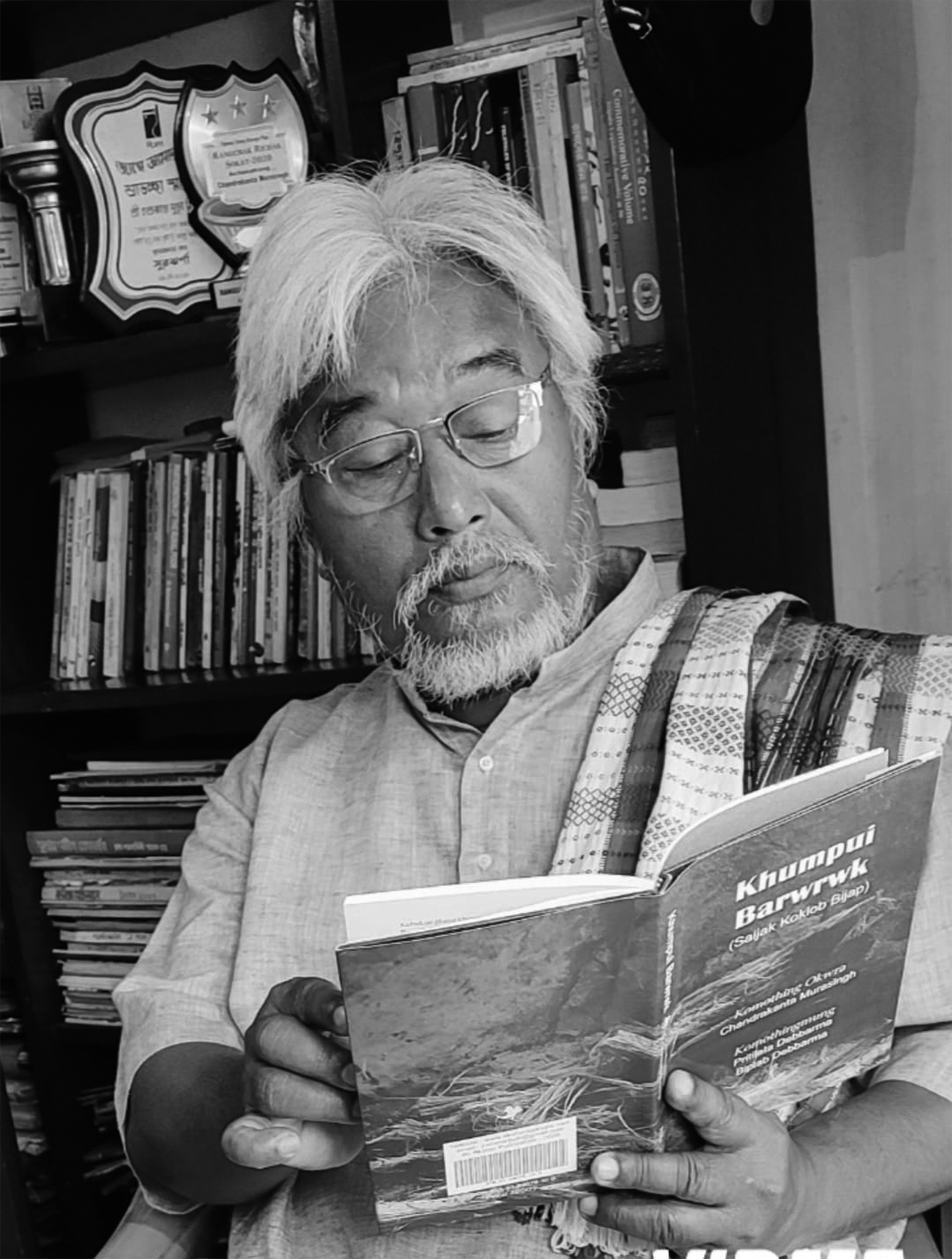
Sometimes he becomes a stone that speaks in the forest, and sometimes he becomes a river that, neglected and suppressed, has lost its identity. Chandrakanta Murasingh is an outstanding poet whose work is deeply rooted in his native soil, expressed with natural ease and spontaneity. He represents the language kokborok, which has a long history of marginalisation.
He was born on 1st April 1957 into a family of shifting cultivators in a remote village called Twiuandal far away from the state capital Agartala in Sepahijala district. His literary journey started from editing a school magazine named Yatri. Some called him the Rabindranath Tagore of Tripura. The statement is well justified since he become the first person from North East India to win the prestigious Sahitya Akademi Bhasa Samman Award in 1996. He was also awarded the Legend of North-East by The Telegraph India, and the Rabindra Puraskar — the highest state award given by the state government of Tripura. He has seven titles of poetry collections to his credit. He also has a considerable number of his poems translated to English, found in Indian Literature, the Journal of Sahitya Akademi, in Anthology of contemporary Poetry from the North-East published by NEHU, and also in anthologies published by Oxford University Press and Penguin Books.
Murasingh, has translated Tagore’s Nobel winning Gitanjali into the kokborok language. The translation was published by Viswa Bharati. Anthologies of his poems, based primarily on love and nature, have been published by North Eastern Hill University and even Oxford University Press. He participated thrice in the National Poetry Festival of Bangladesh, and was also invited, and participated, in the Literary Commons festival in Monash University (Melbourne) Australia in 2016.
His poems have been translated into various Indian languages including Bengali and Hindi, but also into German, Swedish and English. The Hindi department of Calcutta’s Presidency University has published a volume called Chandrakanta Murasingh ke shreshtha kabitae which include a 100 of his poems, all translated into Hindi.
His book Kokborok Ragini tei Jaduni Khorangpili is a musical notation, or “grammarbook”, for learning Tripura’s rich indigenous Tipra folk songs called Jaduni. Tipra folk songs are preserved through oral tradition and are sung with indigenous Tipra instruments like sarinda and chongpreng, but this book records Tipra folk songs and makes them easily learned. Murasingh was also the director of Sahitya Akademi’s NECOL (North-East Centre for Oral Literature).
In the early 1980s, Northeast India saw significant separatist activity, ethnic tension, and insurgency problems, including in Tripura. People were caught between separatist movements led by insurgent groups and countermeasures carried out by the Indian armed forces. At that time, North East India saw the rise of many extraordinary poets whose writing gives a new height to Indian literature. Chandrakanta Murasingh was one of them. His poems documented the hardships of contemporary life in Tripura, a land then marked by the disconcerting presence of both extremists and the Indian Army.
“The forest of chhamanu is a free area now.
It is the liberated zone.
The ‘free’ terrorists can enter any house here
And turned it into ‘headquarters’ or
‘Area command’.
The forest of chhamanu is the ‘free’ area now---
Here, the ‘free’ security forces in search of terrorists,
Can satisfy their lust on anyone they like.”
The lines above are from the poem “Liberated Sons of Manu” by Chandrakanta Murasingh, which brings to light how this newfound freedom can be easily manipulated and exploited, with both “Free’ terrorists” and “security forces” taking advantage of their newfound liberties.
Murasingh was a leftist ideologically but was never involved in party politics. He always questioned the political powers through his poems.
“The minister has no inside, nor outside. No air, no fertile soil of the sandbank. There are only words, the call of hundred open roads, Pulling at the sleeves day and night.”
These lines, from the poem ‘Of a Minister’ by Chandrakanta Murasingh, expresses the inanity in the existence of the ministers. A minister is described as a person who has neither an outside nor an inside. Murasingh criticizes the minister’s lack of empathy and understanding. The promises made by the minister are nothing but hollow words.
Considered one of the greatest Kokborok poets, Chandrakanta Murasingh (66 years of age) passed away on 27 March 2023 following a sudden cardiac arrest. He will be remembered as the ambassador of Kokborok poetry across the country and world, and for his poems and poetic characters like Hachukrai and Goronti.
“Rain means gathering of broken hearts
On the river bank”
— lines from his poems “Rain” published in the book 100 love poems from India, edited by Abhay K.
Lincoln Murasingh is a poet and translator from Tripura’s capital Agartala, India.